
Upper Back Liposuction: Why It Matters for Lipo 360 and BBL Contouring
Upper back liposuction is an important part of creating a balanced back-to-waist-to-buttock silhouette. I do not treat the back as one small, isolated area. For comprehensive body contouring, I assess how the upper back, bra-line region, mid-back, flanks, waist, lower back, and buttocks visually connect.
This approach is especially important for people considering Lipo 360, body contouring after previous liposuction, or a Brazilian butt lift (BBL) plan that relies on shaping the areas surrounding the buttocks.
Removing fat only from the lower back may improve localized fullness, but it may not create the smooth, continuous contour many patients want. A successful contouring plan should consider how the entire posterior torso contributes to the final shape.
What Is Upper Back Liposuction?
Upper back liposuction targets localized fat deposits on the upper portion of the back, including the areas below and around the shoulder blades and along the upper bra line. It is also sometimes referred to as bra roll liposuction or upper-back fat removal.
In a comprehensive back-contouring plan, the upper back contributes to how the waist and buttocks appear when the body is viewed from behind.
I consider upper back liposuction a shaping procedure, not simply a fat-removal procedure. The objective is to create smoother transitions across the back while preserving a natural-looking, proportional silhouette.
For some patients, the upper back is the overlooked portion of a previous liposuction procedure. They may have had fat removed from the lower back, flanks, and waist but still notice upper-back fullness or bra-line rolls. This difference can make the final contour appear incomplete even when the lower areas have been treated.
Why the Upper Back Affects the Ogee Silhouette
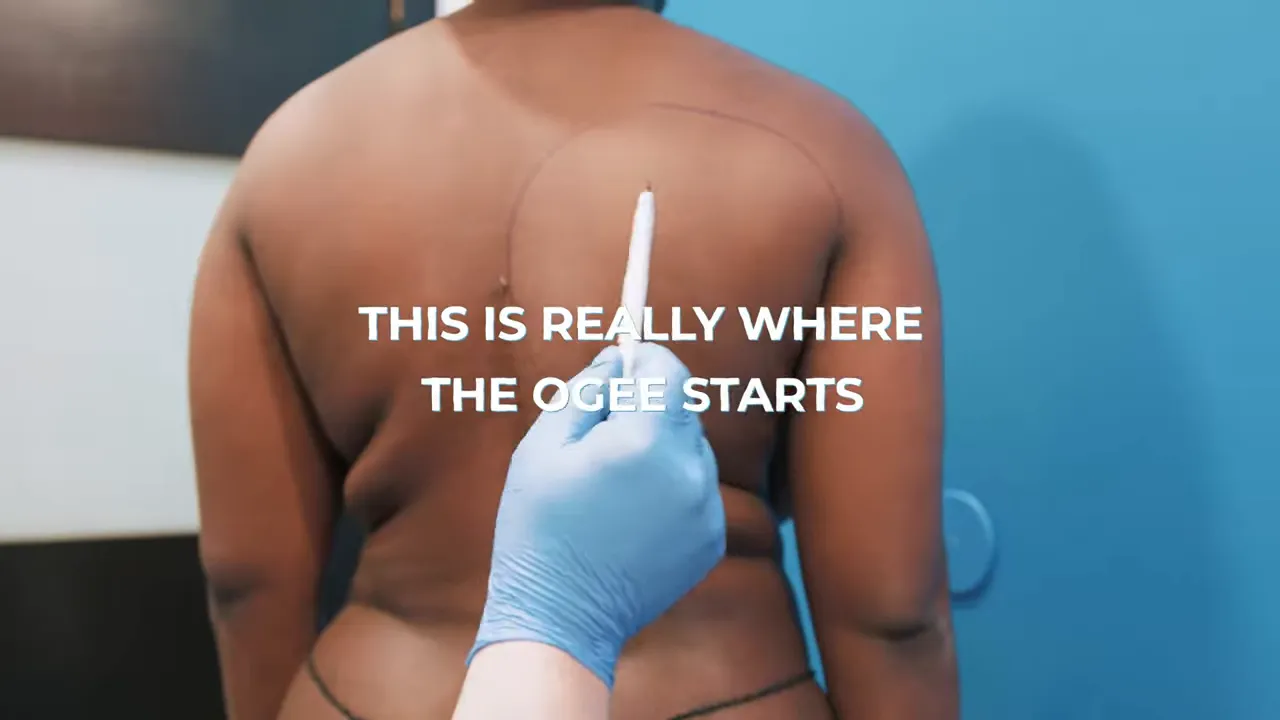
An ogee line is a flowing contour created by alternating convex and concave curves. In body contouring, the upper back can form part of the upper curve before the silhouette transitions through the waist and toward the buttocks.
When upper-back fullness remains untreated, the body’s shape may appear less defined. Treating only the lower back may improve the transition near the buttocks, but it does not necessarily address the contour higher on the torso.
For that reason, the upper back should be evaluated as part of a larger visual pathway:
- Upper back: Contributes to the high point and upper contour of the back.
- Mid-back and bra-line area: Affect the smoothness of the transition down the torso.
- Lower back and flanks: Help define the waistline.
- Buttock region: Completes the lower portion of the overall silhouette.
The appropriate treatment areas are different for every patient. Some people have significant upper-back fullness, while others have relatively little fat in that area. A personalized liposuction plan should be based on the patient’s anatomy, fat distribution, skin quality, previous procedures, and overall body-contouring goals.
Suggested image alt text: Upper back marked before liposuction as part of a comprehensive Lipo 360 and BBL contouring plan.
Why Upper Back Liposuction Requires Careful Access Planning
A common misconception is that one incision can provide complete access to the entire back. In reality, liposuction cannulas are straight, rigid instruments. They cannot safely bend around body contours or reach every part of a broad treatment area from one small entry point.
For this reason, upper-back liposuction may require thoughtfully positioned access sites. The purpose is not to create unnecessary incisions. It is to allow the surgeon to reach the planned treatment areas from angles that support complete, controlled, and even contouring.
For example, access from a lower incision may provide an effective path to portions of the lower back, but it may not adequately reach fat located high on the upper back. A separate, higher entry point may allow the cannula to approach that area more directly. Additional access from the front or side may also be used to reach the lateral portions of the contouring zone.
This multi-angle approach can be particularly relevant during revision liposuction. If a previous procedure focused mainly on the lower back, flanks, or another limited zone, the untreated upper back may require a different access strategy.
Suggested image alt text: Straight liposuction cannula positioned across the upper back to demonstrate access planning.
How Multiple Treatment Directions Help Create an Even Result
Liposuction removes fat along the pathways traveled by the cannula. If treatment is performed in only one direction, fat removal may follow a series of parallel tracks.
To provide more even coverage across a treatment zone, the surgeon may need to approach the area from more than one direction. I think of this as cross-pattern liposuction treatment.
One set of cannula paths addresses the area in one direction, while another set crosses those paths at approximately a right angle. This technique can help produce more uniform fat removal throughout the selected area.
This principle is particularly important during upper back liposuction because the back is broad and curved. The surgeon needs sufficient access and directional control to address the planned region without leaving partially treated areas between the cannula pathways.
Cross-pattern treatment is designed to help avoid:
- Untreated strips of fat between parallel cannula pathways
- An incomplete transition from the upper back toward the waist
- Overreliance on one incision that cannot safely reach the full treatment area
- Improvement in the lower back while upper-back fullness remains unchanged
- Visible differences between treated and untreated contouring zones
Upper Back Liposuction as Part of Lipo 360
Lipo 360 generally refers to circumferential liposuction around the torso. Although individual treatment plans vary, the procedure involves more than addressing the abdomen or removing one isolated back roll.
From a comprehensive body-contouring perspective, the upper back can be a meaningful component of a full-torso assessment.
Including the upper back may be particularly beneficial when the goal is to create a more continuous posterior contour. Upper-back treatment can help visually connect the upper torso with the waist and lower-back shaping instead of creating a noticeable break between treated and untreated areas.
However, Lipo 360 should not be treated as a fixed checklist. The exact areas requiring treatment depend on the patient’s anatomy, fat distribution, prior surgical treatment, skin quality, and desired contour.
A patient with minimal upper-back fat may not need the same approach as someone with persistent upper-back or bra-line fullness after previous liposuction. The term “Lipo 360” does not automatically mean that every patient will have the same areas treated in the same way.
How Upper Back Contouring Can Complement a BBL
A Brazilian butt lift involves more than transferring fat to the buttocks. The appearance of the final result is also influenced by the contours surrounding the buttocks.
Liposuction of the waist, flanks, lower back, and—in appropriate patients—the upper back can help create a clearer visual transition from the torso to the buttocks. This surrounding contouring may make the waist appear more defined and allow the buttock shape to fit more cohesively within the patient’s overall proportions.
Upper-back liposuction does not enlarge the buttocks. Instead, it may support the overall back-to-waist-to-buttock silhouette by improving the areas above the waist.
Fat removal and fat transfer must always be planned according to the patient’s anatomy and safety. More aggressive liposuction or a larger fat transfer does not automatically produce a better result.
Upper Back Liposuction After Previous Liposuction
Revision liposuction requires especially careful planning. A patient may seek another procedure because the previous operation did not adequately include the upper back—not because every previously treated area needs additional liposuction.
Before considering revision body contouring, I focus on three practical questions:
1. Which area still concerns the patient?
The first step is identifying whether the remaining concern is high on the back, near the bra line, along the flanks, or lower near the waist and buttocks.
2. Was that area treated during the previous procedure?
Existing incision locations, operative information, and the patient’s current contour may help indicate which areas were previously addressed and where access may have been limited.
3. How does the area affect the entire silhouette?
The remaining fullness should be evaluated in relation to the back, waist, hips, and buttocks. That relationship helps determine whether upper-back treatment belongs in the revision plan.
The key lesson is that additional liposuction should have a defined contouring purpose. More treatment is not automatically better. The plan should address the specific area contributing to an incomplete or unbalanced result.
Who May Benefit From Upper Back Liposuction?
Upper back liposuction may be considered for patients who have:
- Persistent fullness along the upper back or bra-line area
- Upper-back fat that does not respond adequately to diet and exercise
- A visual difference between a previously treated lower back and an untreated upper back
- Back and waist contouring goals as part of Lipo 360
- A BBL plan in which surrounding torso contouring may improve overall proportions
- Realistic expectations about what liposuction can accomplish
Liposuction is not a weight-loss treatment, and it cannot correct every type of back fold or skin laxity. Some folds may be affected by loose skin, posture, muscle structure, or natural anatomy rather than fat alone.
A consultation is necessary to determine whether upper back liposuction is appropriate and how it should fit into a broader body-contouring plan.
Questions to Ask During an Upper Back Liposuction Consultation
A useful consultation should go beyond asking whether upper-back fat can be removed. Patients should ask how the surgeon plans to create a cohesive shape across the back, waist, and surrounding areas.
Consider asking:
- Is the upper back included in my Lipo 360 plan?
- Which upper-back areas are contributing to my current contour?
- How will upper-back treatment connect visually with my waist and lower back?
- Would upper-back liposuction complement my BBL plan?
- Will previous liposuction or existing scars affect the surgical approach?
- What access points may be needed to reach the planned treatment areas?
- How will the treatment plan reduce the risk of leaving an incomplete or unevenly treated zone?
- Is my concern caused primarily by fat, loose skin, or a combination of factors?
These questions help shift the conversation away from how much fat will be removed and toward the strategy behind the contour.
Common Upper Back Liposuction Mistakes to Avoid
Focusing Only on the Lower Back
The lower back is important for creating the waist-to-buttock transition, but it is only one part of the posterior contour. Ignoring significant upper-back fullness can limit the visual effect of lower-back liposuction.
Assuming One Incision Can Reach Everything
Because a liposuction cannula is straight and rigid, incision placement affects which areas can be reached. A limited entry point may not provide a practical path to fat located high on the upper back.
Thinking Liposuction Is Only About Spot Reduction
Upper back liposuction is most effective when planned in relation to the surrounding contour zones. The objective is a smooth, proportional transition across the back, waist, and buttock region—not simply removing fat from one isolated roll.
Overlooking Previous Surgical Treatment
Prior liposuction may help explain why a particular area remains full. A revision plan should identify what was not adequately treated instead of automatically repeating the same surgical approach.
Assuming Every Patient Needs the Same Lipo 360 Plan
The term “Lipo 360” describes a circumferential approach, but it does not replace individualized surgical planning. The best treatment areas depend on each patient’s anatomy and goals.
Key Takeaway: Upper Back Contouring Can Complete the Back
Upper back liposuction can make a meaningful difference when it is included in an intentional Lipo 360, BBL, or revision body-contouring strategy.
By evaluating the back from the upper torso through the waist and buttocks—and treating the appropriate areas from carefully selected access points and directions—it is possible to address the full contour rather than concentrating only on the waist or lower back.
The most important consideration is comprehensive and individualized planning. A balanced result depends on evaluating the entire back and understanding how each treatment area contributes to the final silhouette.
Upper Back Liposuction FAQ
Is upper back liposuction part of Lipo 360?
It can be. Lipo 360 involves circumferential torso contouring, and upper-back liposuction may be included when fullness in that area affects the desired back and waist silhouette. Treatment areas should be selected according to the patient’s anatomy rather than a standard checklist.
Is upper back liposuction the same as bra roll liposuction?
The terms overlap, but they are not always identical. Bra roll liposuction generally refers to fat around the bra-line area, while upper back liposuction may include a broader portion of the upper back and areas around the shoulder blades.
Can upper back liposuction improve a BBL result?
Upper back liposuction does not increase buttock volume. However, contouring the back, waist, and flanks may improve the proportions surrounding the buttocks and create a smoother back-to-waist-to-buttock transition.
Why might upper-back fat remain after previous liposuction?
A previous procedure may have concentrated on the lower back, flanks, or waist without adequately treating the higher upper-back area. Incision placement and access limitations can also affect which zones the surgeon can effectively reach.
Why are multiple incision sites sometimes used?
Straight liposuction cannulas cannot bend around the body’s contours. More than one access point may allow the surgeon to approach different parts of the upper back directly and from useful treatment angles.
What does cross-pattern liposuction mean?
Cross-pattern liposuction refers to treating an area from multiple directions so that the cannula pathways intersect. The objective is to provide more consistent coverage across the planned treatment area.
Can upper back liposuction remove bra rolls completely?
Results depend on the amount and location of fat, skin elasticity, natural anatomy, and other individual factors. Liposuction can reduce localized fat, but folds caused partly by loose skin or structural anatomy may not disappear completely.
Is upper back liposuction a weight-loss procedure?
No. Liposuction is a body-contouring procedure intended to reshape localized fat deposits. It is not a substitute for weight loss, healthy eating, or regular physical activity.
Schedule a Body-Contouring Consultation in Miami
If you are considering upper back liposuction, Lipo 360, revision liposuction, or a Brazilian butt lift in Miami, the first step is a personalized evaluation. Dr. William can assess how your upper back, bra-line area, waist, flanks, lower back, and buttocks work together and recommend a treatment plan based on your anatomy and goals.
Request a consultation with Dr. William
Want to see Dr. William explain why upper-back treatment matters and how access points affect the result?
Watch the upper back liposuction video on YouTube